Do the rankings agree?
Compare the proxy with the target on matched samples using Pearson r and Spearman ρ.
COHE: Auditing Non-Transitivity in Sample Difficulty Proxies for Vision Models
NeurIPS 2026 · Evaluations & Datasets
Seoul National University of Science and Technology
1 Department of Defense Artificial Intelligence Applications
2 Department of Computer Science and Engineering
TL;DR: DINOv2 isolation predicts when samples are first learned, yet training on its hardest-ranked samples reduces accuracy in the tested settings.
Conference recordCOHE compares reconstruction error, denoising error, token likelihood and DINOv2 isolation with supervised difficulty targets. Experiments measure rank agreement and held-out prediction, then test subset selection, full-data sample ordering and retrieval against matched baselines.
Read the full abstract in the paperCompare the proxy with the target on matched samples using Pearson r and Spearman ρ.
Fit on the training split and measure R² on held-out target values.
Compare the declared policy with a matched baseline, including uncertainty in the downstream metric.
The paper calls this non-transitivity: ranking agreement, held-out prediction and downstream benefit do not automatically imply one another.
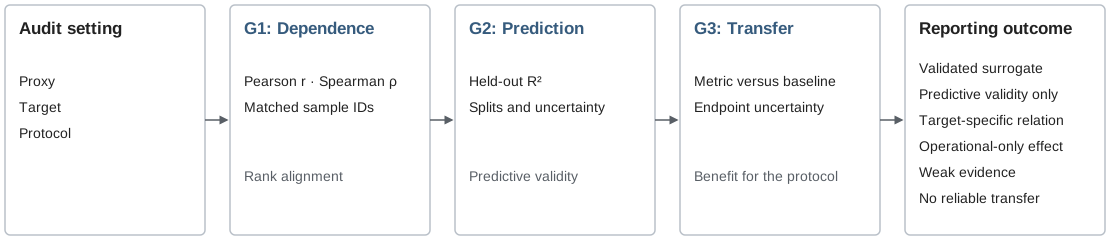
The paper groups audit reports into six tiers for the stated proxy, target and protocol.
An unmeasured gate is not a failure. A failed G3 preserves positive G1/G2 evidence; auxiliary-target relations retain their own label.
Definitions and assignment orderSelection, ordering and retrieval test different uses of a difficulty score.
In the DINOv2 and DDPM difference plots, negative values favor the baseline. Whiskers are paired Student-t 95% confidence intervals.
CIFAR-100, DINOv2 isolation
Hard-only selection underperforms Random in every tested condition.
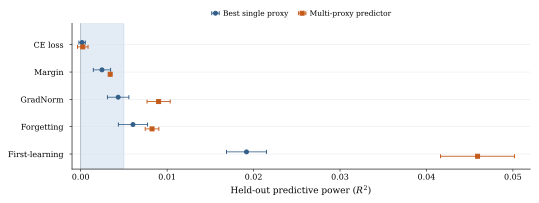
For first-learning, rank correlation is ρ = 0.4363and held-out prediction is R² = 0.2126. This auxiliary-target relation measures when samples are learned; the selection experiment below measures test accuracy.
Seed records| Selection | Hard | Random |
|---|---|---|
| 10% subset | 10.77 | 25.64 |
| 30% subset | 26.47 | 43.72 |
| 50% subset | 40.57 | 51.68 |
| Balanced 10% | 14.11 | 25.51 |
CIFAR-100, DDPM difficulty scores
Easy-to-Hard and Shuffled-Proxy Order both fall below global Random ordering.
Seed recordsImageNet-1K, VAE reconstruction scores
Class-balanced VAE-hard selection underperforms balanced Random.
Seed recordsVAE: stabilityai/sd-vae-ft-mse normalized-pixel reconstruction MSE. The largest scores are selected within each training class. Validation data is used for checkpoint selection and evaluation.
Final-epoch sensitivity: −7.854 pp, 95% CI [−8.442, −7.266].
From the artifact repository root, provide your scalar scores, a fixed prediction split and completed policy results. These interface commands produce statistics; they do not decide whether a gate passes or assign a reporting tier. Match scores by unique sample_id; the scripts use the IDs shared by the input files. Define both scores so larger values mean harder samples, and record the target, learner and policy being audited.
| File | Columns | Contents |
|---|---|---|
my_proxy.csv | sample_id,proxy_score | One scalar proxy score per sample. |
my_target.csv | sample_id,target_score | One scalar value of the declared target per sample. |
my_splits.csv | sample_id,split | Fixed train or test assignment; at least two training samples and a nonconstant held-out target. |
my_transfer.csv | method,budget,seed,accuracy | Completed runs, with a Random baseline at each budget and accuracy in the same units for every method. |
# G1: Pearson r and Spearman rho
python scripts/run_stage1_dependence.py \
  --proxy my_proxy.csv --target my_target.csv \
  --out outputs/my_g1.csv

# G2: held-out R² from a one-dimensional linear fit
python scripts/run_stage2_prediction.py \
  --proxy my_proxy.csv --target my_target.csv \
  --splits my_splits.csv --out outputs/my_g2.csv

# G3 summary only, no pass/fail: mean differences versus Random
python scripts/run_stage3_transfer_summary.py \
  --transfer my_transfer.csv --out outputs/my_g3_summary.csv
G3 summary only, no pass/fail. The script averages supplied runs by method and budget without pairing seeds or estimating confidence intervals. Its output cannot establish a G3 pass. G2 likewise reports a single linear fit; split variability and the declared prediction criteria require separate evaluation.
For the paper’s accuracy comparisons, pair policy and baseline runs by seed and compute a 95% confidence interval for the paired differences. The lower bound must be above zero, together with the declared endpoint and protocol checks, before reporting a G3 pass. A positive mean difference alone is insufficient.
After evaluating uncertainty and the predeclared criteria, record each gate as passed, failed, inconclusive or unmeasured for the same proxy, target and protocol. Then apply the paper’s assignment order manually:
Keep unmeasured gates distinct from failures, and report the audited setting and uncertainty with the assigned outcome.
The v1.0-neurips2026 release includes code, seven CIFAR-100 proxy arrays, aggregate and seed-level records, and 234 author-trained checkpoints.
From the artifact repository root, verify all released DINOv2 conditions, DDPM ordering pairs and ImageNet-1K endpoints against completed experiment records:
python scripts/reproduce.py --experiment paper_results| Experiment | Code | Aggregates | Seeds | Checkpoints | Notes |
|---|---|---|---|---|---|
| CIFAR-100, ResNet-18 | Training | Available | Available | 120 | Dataset and score inputs required. |
| CIFAR-100, ResNet-50 | Training | Available | Available | Not retained | Second-learner results remain available. |
| DINOv2 selection | Selection | Available | Available | Not retained | Scalar ranks and all reported conditions included. |
| DDPM ordering | Ordering | Available | Available | 18 of 24 | Random and Easy-to-Hard seeds 0–2 are missing. |
| ImageNet-10 | Scoring / fine-tuning | Available | Available | Not retained | Imagenette and score inputs required. |
| ImageNet-1K VAE selection | Scoring / training | Available | Available | 20 | ImageNet, VAE weights and training scores required. |
CPU commands check released records. Regenerating scores and training models require upstream datasets, weights and experiment inputs; some historical source settings remain incomplete.
Reproduction guideCheckpoint inventory@inproceedings{jeong2026cohe,
title = {COHE: Auditing Non-Transitivity in Sample Difficulty Proxies for Vision Models},
author = {Jeong, Dayena and Choi, Sunglok},
booktitle = {Advances in Neural Information Processing Systems},
year = {2026},
note = {Evaluations \& Datasets Track},
url = {https://neurips.cc/virtual/2026/poster/139659}
}